


A home’s roof is its first and most fundamental line of defense against the elements. Its shape, pitch, and complexity are often chosen for aesthetic appeal, but they also serve a critical engineering function: managing precipitation. However, the roof itself is only half of the water management equation. The other, equally vital component is the eavestrough or gutter system. This system is not a mere accessory; it is a crucial network designed to collect the water channeled by the roof and direct it safely away from the home’s foundation, siding, and landscaping.
The relationship between a roof’s architecture and its gutter system must be harmonious. A mismatch can lead to a cascade of costly problems, from basement flooding and foundation cracks to siding rot, landscape erosion, and dangerous ice dams. In a climate like Calgary’s, which experiences heavy snowfall, rapid chinook-driven melts, and intense summer downpours, a properly designed and installed gutter system is non-negotiable.
There are many different roof types in the world, although some are more popular in Calgary. Sometimes these are a matter of personal preference. On other occasions, a local building regulation may dictate a particular roof shape. While many variations exist, in Calgary, we are most likely to encounter flat, mono-pitch, gabled, cross-gabled, hipped, and half-hipped roofs. Each presents its own unique guttering challenges in terms of channeling roof moisture away effectively.
A Deeper Look at Common Roof Types and Gutter Strategies
 1. Flat Roofs
 1. Flat Roofs
Contrary to their name, modern flat roofs are seldom perfectly flat. They are technically “low-slope” roofs, incorporating a gentle pitch (often as little as 1/4 inch per foot) to guide water toward drains. While common on traditional buildings in arid areas, they are now widely used on modern homes and large commercial buildings thanks to advanced waterproofing membranes.
- The Guttering Challenge: Flat roofs present a unique challenge as they don’t use conventional eavestroughs. Instead, they typically rely on one of two systems:
- Internal Drains: Water is channeled to drains located in the middle of the roof, which then connect to pipes that run down inside the building’s walls.
- Scuppers and Collector Boxes: Water is directed to openings (scuppers) along the edge of the roof’s parapet (a low protective wall). This water shoots out of the scupper and into a “collector box,” which is essentially a funnel that connects to a downspout.
- The Risk: The primary danger is “ponding”—water pooling in low spots duefs to an insufficient slope or clogged drains. In winter, this pooled water can freeze, expand, and compromise the roofing membrane. A blocked scupper or drain can quickly turn the entire roof into a shallow, extremely heavy pool, posing a serious structural risk.
2. Mono Pitched Roofs (Shed Roofs)
Also known as shed, skillion, or lean-to roofs, this design features a single, sloped surface, often set between a higher and a lower wall. It’s a popular choice for modern architecture, home additions, and, of course, sheds.
- The Guttering Challenge: The mono-pitched roof’s defining feature is its primary challenge: it collects 100% of the precipitation that falls on its entire surface area and delivers it to one single edge. This concentrates an immense volume of water into one line of gutter.
- The Solution: Standard 5-inch gutters are almost always insufficient for a mono-pitched roof of any significant size. An oversize, 6-inch gutter is typically necessary to handle the sheer volume and prevent overflow during a downpour. Just as importantly, this system requires larger or more numerous downspouts to evacuate the water from the trough quickly. The weight of this water (and potential snow and ice) also puts significant stress on the gutter hangers and fascia board, requiring a robust and secure installation.
3. Gable Roofs
The gable roof is the iconic, A-frame design seen on countless homes. It features two sloping sides that meet at a central ridge, with a triangular wall (the “gable”) at each end.
- The Guttering Challenge: Guttering a standard gable roof is relatively straightforward, consisting of two long, straight runs along the two lower eaves. The main challenge isn’t complexity, but managing water volume and velocity. On a steep-pitched roof, water can gain significant speed, potentially “overshooting” the gutter entirely.
- The Solution: Ensuring the gutters are of adequate size (5″ or 6″) for the roof area is key. In cases of overshoot, “splash guards” can be installed on the outer lip of the gutter to catch the fast-moving water. While the gable ends themselves don’t have gutters, they are vulnerable to water damage if the roof lacks a sufficient overhang, allowing rain and meltwater to run down the siding.
4. Cross Gabled Roofs
A cross-gabled roof consists of two or more gable roof sections that intersect, often at a right angle. This design is common on homes with a more complex floor plan, such as those with projecting wings or attached garages.
- The Guttering Challenge: This is one of the most complex roofs to gutter correctly. The point where two roof planes meet forms an internal channel called a “valley.” These valleys collect water from both intersecting roof surfaces and funnel a high-velocity, highly concentrated torrent of water down to one small point at the gutter line.
- The Risk: This concentrated flow almost always overshoots a standard gutter corner. It can also cause massive erosion of roofing granules over time. This complexity, with its multiple corners and high-flow intersections, dramatically increases the risk of common gutter problems, including leaks, blockages, and overflow. Specially designed valley splash guards and high-flow mitered corners are essential to manage the water effectively.
5. Hipped Roofs
 5. Hipped Roofs
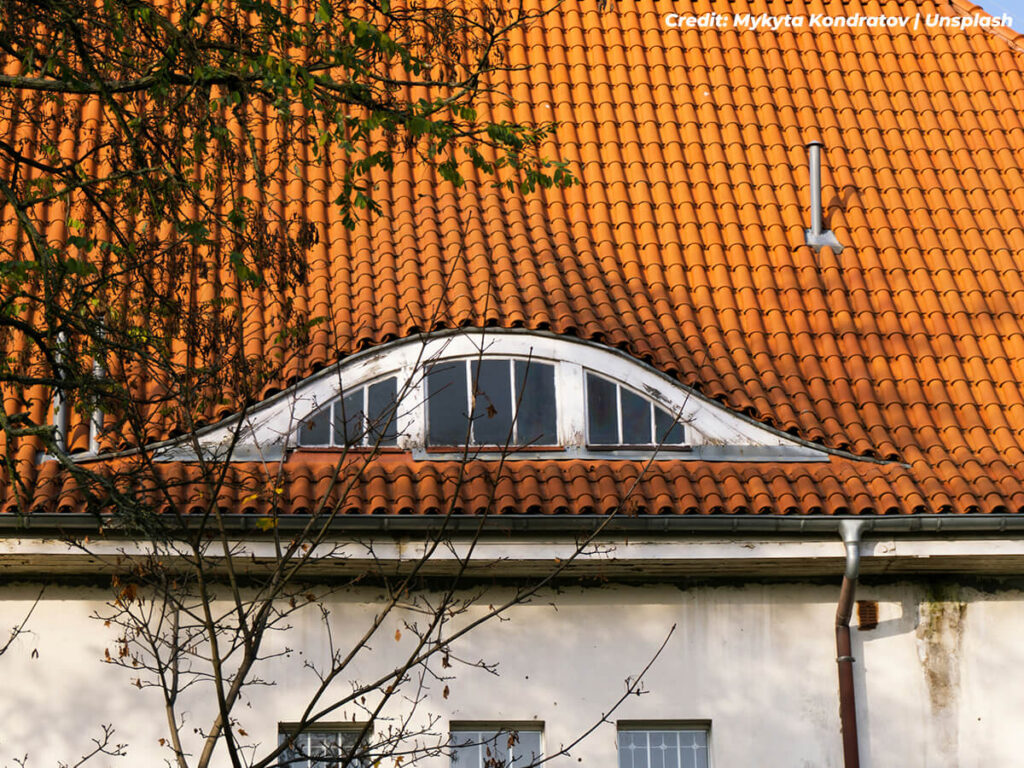
A hipped roof slopes down on all four sides of the building, which may join at a single apex (a “pyramid” or “tent” roof) or along a central ridge. This design is very popular for its stability and resistance to high winds.
- The Guttering Challenge: The primary benefit of a hipped roof is also its main guttering consideration. Because the total roof area is divided across four (or more) sides, the volume of water per linear foot of gutter is generally less than on a gable or mono-pitch roof. This can sometimes allow for a standard 5-inch eavestrough.
- The System: The challenge here is not volume, but continuity. A hipped roof requires a continuous gutter system that wraps around the entire perimeter of the home. This means navigating at least four corners (miters). Every corner joint is a potential point of failure, requiring meticulous sealing and proper installation to prevent leaks over the long term.
6. Half Hipped (Clip Gabled) Roofs
This roof is a hybrid design, functioning as a variation of a hipped or gable roof. It features a hip that does not extend all the way down to the gutter line, leaving a small, high gable (the “clip”) at the top of the wall.
- The Guttering Challenge: In many cases, builders and roofers neglect to install a gutter on this small, “clipped” end. This is a critical oversight. While the roof plane is small, it still collects water, which then drips down the wall, staining the siding, eroding mortar, and splashing onto people below.
- The Solution: This problem is easily solved with the installation of an additional, small eavestrough section across the clipped gable’s eave. As seen in the accompanying photo, this small gutter captures the runoff and directs it into a new downspout, properly managing the water and protecting the wall from chronic moisture damage.
The Right Gutter for the Right Roof
A roof’s design is the first half of your home’s water management story; the gutter system is the second, equally important half. A “one-size-fits-all” approach to eavestroughs is a recipe for failure. A mono-pitch roof has vastly different requirements than a complex, cross-gabled roof.
Choosing the right gutters Calgary residents need means conducting a thorough assessment of the home’s specific architecture. This includes not only the roof’s shape and pitch but also its total square footage (which determines the total water volume) and the number and location of valleys. Only by considering all these factors can a gutter system be designed and installed to protect your home effectively for decades to come.
We welcome all inquiries. Email Valiant Exteriors or call 403-829-1661 for more advice on gutters and roof types. If are in Calgary and need a consultation on your eavestroughing, gutters, siding, or any other exterior renovation project, we are at your disposal.