

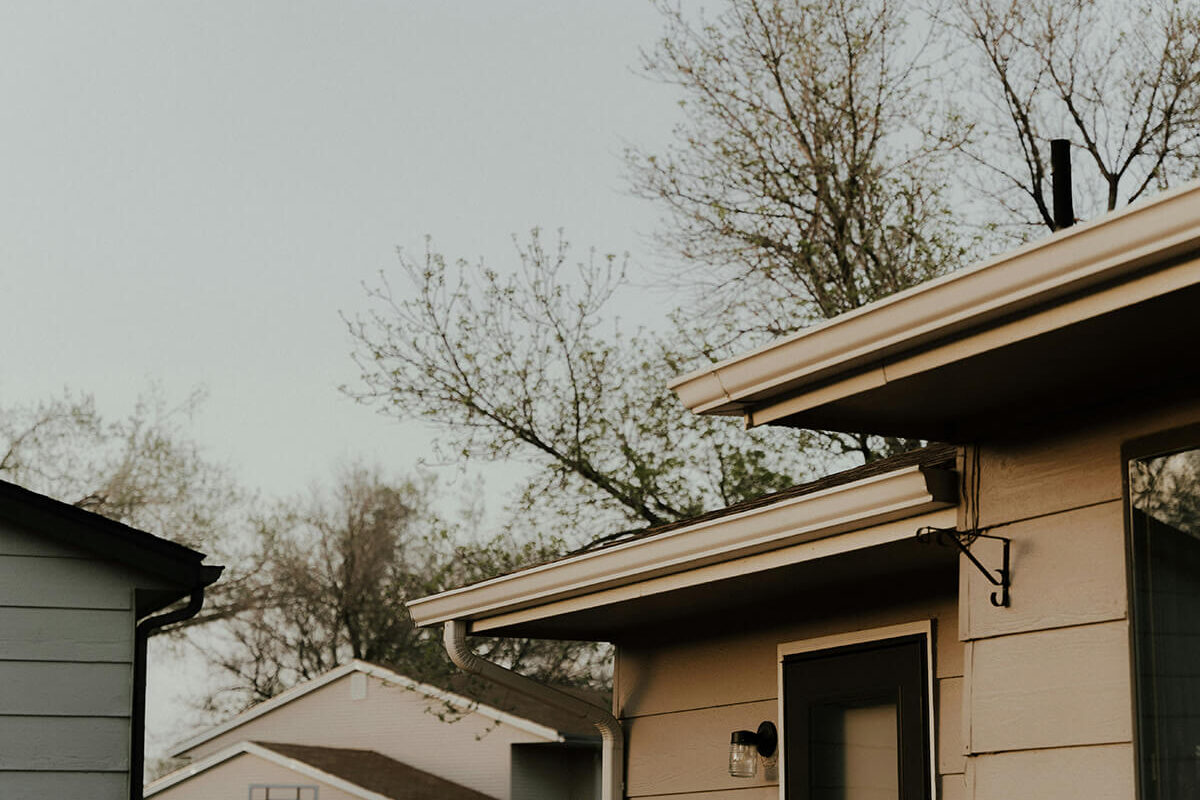
On the face of it, installing eavestrough gutters in Calgary is the simplest of jobs. The gutters come seamlessly out of a machine, while the bends and downpipes are pre-assembled. When the householder comes back from work, they are delighted with what they see.
But they don’t climb up on the roof to examine the gutters from the top. They almost never do. There are many so-called roofing, guttering, fascia and soffit ‘experts’ in Calgary who take advantage of this fact. We wrote this post so you know what to insist on before accepting a quote.
 The “Frost-Free” Fallacy: A Recipe for Disaster
 The “Frost-Free” Fallacy: A Recipe for Disaster
In warmer, frost-free climate zones, gutter installers can get away with a very simple, fast installation. They often just drive screws through the inside (back) edge of the gutter, through the fascia board, and into the rafter tails. This method is quick, cheap, and sufficient to withstand the weight of liquid rainwater, provided the downpipes are clear and the water can flow freely away.
If this method is used in Calgary, it is a guaranteed failure.
Our climate introduces a destructive force that “frost-free” zones never contend with: ice.
Here’s the catastrophic sequence of events:
- Heat Loss: Heat from your home’s living space escapes into the attic, warming the underside of the roof deck.
- Snow Melt: This warmth melts the bottom layer of snow on your roof, even when the air temperature is below freezing.
- Refreezing: The resulting meltwater runs down the roof slope until it hits the cold eave and gutter, which overhangs the heated part of the house. Here, it refreezes.
- The Ice Dam: Day after day, this process repeats. An expanding block of solid ice, known as an ice dam, forms inside the gutter.
This is where the “frost-free” installation method fails. That gutter, attached only by its back edge, has zero support for its outside edge. The immense weight of the ice—which can be hundreds of pounds—pulls the gutter down. Worse, as the ice expands, it pushes outward, buckling the unsupported front edge and permanently deforming the gutter.
The weight transfers entirely to those few screws on the inside edge. Eventually, a strong wind or the simple, crushing weight of the ice block will tear the entire eavestrough system away from the fascia, often taking the fascia board with it.
The Calgary Solution: Transforming a Trough into a Structure
A professional Calgary gutter installer knows they aren’t just hanging a “trough.” They are building a “structure” capable of withstanding massive, seasonal loads.
To do this, they must bridge across the open top of the gutter, connecting the outer and inner edges. This simple addition transforms the “C” shape of the gutter into a rigid, rectangular “box.” This structure is exponentially stronger and can resist the twisting, buckling, and pulling forces of ice and snow.
This “bridge” also serves as the attachment point, transferring the load from the entire gutter system (not just the back edge) through the fascia and securely into the structural rafters behind it.
There are two customary ways to create this bridge and fasten the gutter. One is an outdated method prone to failure, and the other is the modern professional standard.
Method 1: Spikes & Ferrules
For decades, the standard for gutter installation was the spike and ferrule method.
- A ferrule is a hollow metal tube, a spacer, cut to the exact width of the gutter trough.
- It’s placed inside the gutter. A long spike (essentially a very long nail, often 7-10 inches) is hammered through the outside edge of the gutter, through the ferrule, through the inside edge of the gutter, through the fascia board, and deep into the rafter tail.
This method does create the “box” structure we discussed and is far superior to back-screwing alone. However, it has a significant, fatal flaw, especially in a climate like Calgary’s: the spike is a nail.
Nails rely on friction to hold. They have no threads. Calgary’s infamous “Chinook” weather means we experience dramatic, rapid thermal cycles. Our homes go from – 30°C to 10°C and back again, sometimes in a single day.
The metal spike and the wood rafter expand and contract at different rates. Every single cycle, the wood fibers compress and release their grip on the spike, “wiggling” it just a tiny fraction. Season after season, this thermal cycling gradually works the smooth spike loose. The hole widens, and the friction grip is lost.
This is, without question, one of the main reasons for sagging gutters in Calgary. Once the spike is even slightly loose, the gutter sags, the slope is ruined, water pools instead of drains, and the ice-loading problem becomes even worse. On top of this, the visible spike head on the gutter’s exterior is an aesthetic drawback and a potential entry point for rust and water staining.
Method 2: Hidden Hangers & Screws
The vastly superior, modern method is the hidden aluminum hanger.
This is a one-piece, engineered bracket that clips securely onto the outer lip of the gutter, spans the top, and rests against the inner wall. The hanger has a pre-drilled hole. A long, high-quality screw is driven through this hole, through the gutter’s back wall, through the fascia, and into the rafter tail.
This system is superior in every conceivable way:
- Superior Holding Power: The fastener is a screw, not a nail. The threads provide a mechanical grip that is highly resistant to pull-out forces and the thermal cycling that plagues spikes.
- Structural Rigidity: The hanger itself is a strong, formed piece of metal that adds immense stiffness to the gutter. It effectively “boxes in” the trough, making it highly resistant to bending, buckling, or deforming under ice, snow, or the weight of a ladder.
- Invisible Aesthetics: As the name implies, the hanger is completely invisible from the ground. This provides the cleanest possible look for your home’s exterior.
Not All Hangers Are Created Equal: Material and Spacing
 Not All Hangers Are Created Equal: Material and Spacing
Simply using a “hidden hanger” isn’t enough. A “pro” can still cut corners by using cheap materials or improper spacing.
Hanger Materials
- Vinyl/Plastic: These are the cheapest option and should be avoided at all costs. They are often marketed to DIYers. Vinyl becomes extremely brittle in Calgary’s deep-freeze temperatures. A heavy ice load or a simple bump from a ladder will cause them to crack and snap. They also degrade and weaken over time from UV sun exposure.
- Steel: Steel hangers are very strong, but they have one major downside: they rust. Any scratch in the protective coating (which inevitably happens during installation) will become a point of corrosion, weakening the hanger and potentially causing rust stains to run down your fascia or siding.
- Aluminum: This is the only material a true professional should use. We only use high-grade aluminum hangers. Aluminum is lightweight, exceptionally strong when formed into a hanger profile, and will never rust. It provides the ultimate combination of strength and long-term durability for your eavestroughing system.
Fastener Spacing
This is the final “gotcha” for a low-bid contractor. To save time and materials, they will space the hangers as far apart as possible, sometimes as much as four feet. This is grossly inadequate.
When a 10-foot section of gutter fills with ice, it can weigh over 250 pounds. With hangers at 4-foot spacing, that load is distributed between only two or three hangers. This puts immense stress on each fastener, which will inevitably fail.
Our professional standard at Valiant Exteriors Inc. is to space our aluminum hangers between 1.5 and 2 feet apart (16 to 24 inches). This spacing isn’t random. Structural rafters in most homes are 16″ or 24″ on center. By spacing our hangers this tightly, we ensure that almost every single screw bites deep into a solid rafter tail, not just the 1-inch fascia board. This provides the most secure, robust, and permanent attachment possible.
The Valiant Standard: Why Your Gutter Choice Matters
Your gutter system is your home’s first and most important line of defense against water damage. A failing eavestrough doesn’t just mean a wet basement. It leads to:
- Water overflowing and saturating your siding.
- Water penetrating behind the fascia, causing rot in your soffits, fascia boards, and roof decking.
- Water pooling at your foundation, leading to cracks, leaks, and catastrophic structural damage.
A cheap gutter job is one of the most expensive “savings” a homeowner can make. The cost of a subsequent repair, which often includes replacing rotted wood and damaged siding, will be far more than the initial cost of doing the job right.
Valiant Exteriors Inc. has a simple policy: we never cut corners. We believe your eavestroughing system is a critical component of a complete exterior renovation. We build it to last, using only the best materials—heavy-gauge aluminum, premium hidden hangers, and high-quality screws—and installing them at the correct professional spacing.
We always achieve the quality we insist on for our own homes. You may pay a little more for our high standards, but we guarantee it will be significantly less than the cost of fixing a sub-standard installation down the road.
Don’t let your home’s critical water management system be its weakest link. If you are in the Calgary area and need a consultation on your gutters, eavestroughing, siding, or any other exterior renovation project, we are here to help.
Call Valiant Exteriors Inc. today at (403) 829-1661 for an honest assessment and a quote you can trust.