

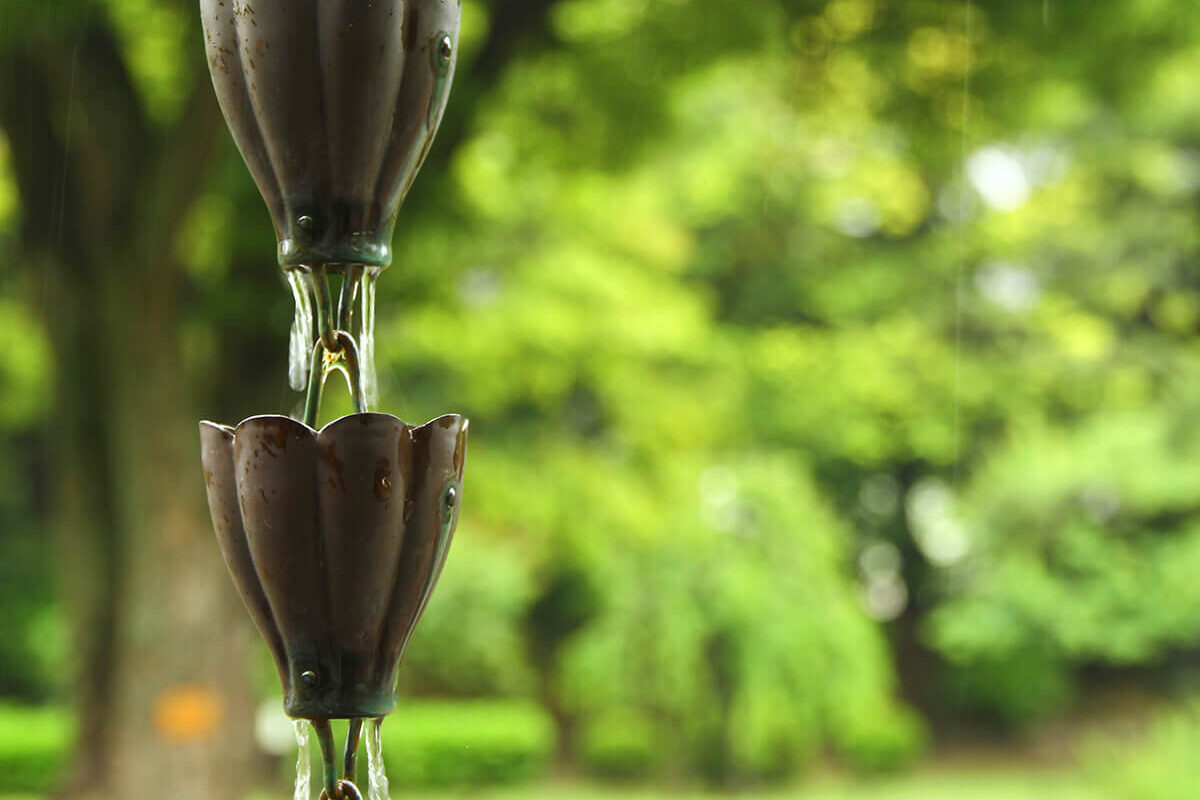
Rain chains, known as kusari-doi in Japan, have a long and storied history. They are treasured in their country of origin for their profound cultural value and intrinsic, meditative beauty, transforming the simple act of rainwater drainage into a sensory experience. In recent years, they have become an innocent-looking fad among some homeowners in Calgary, chosen for their unique esthetic and the gentle sound they make in a light shower.
However, they are no substitute for a modern, engineered drainage system, especially in a climate as demanding and unpredictable as ours.
These “cute ideas” are functionally adequate for transporting very small amounts of rainwater from an eavestrough to a rain barrel, water feature, or a drought-tolerant garden in a mild climate. But unfortunately, they are fundamentally incapable of coping with the volume of water from a heavy rainstorm, the force of a wind-driven downpour, or the perils of a freeze-thaw cycle. What begins as a charming exterior accent can quickly become the catalyst for costly and severe damage to your home.
 The Allure vs. The Reality
 The Allure vs. The Reality
It’s easy to understand the appeal of rain chains. They come in a variety of beautiful styles, from simple links to ornate copper cups, and they turn a mundane function into a visual centrepiece. The sound of water trickling down the chain can add a “zen” quality to a garden.
This appeal, however, is based on their performance in ideal conditions: a gentle, windless rain. The reality of Calgary’s weather is anything but. We face sudden, torrential downpours, hailstorms, heavy snowpack, and high winds. A drainage solution designed for a tranquil Japanese temple garden is tragically mismatched for a home battling a prairie thunderstorm. The functional demands of a drainage system in this region are not aesthetic; they are structural and preventative.
The Critical Engineering of a Modern Drainage System
The flashing, eavestroughs (gutters), and downspouts on Calgary homes form a single, integrated system. Like a well-drilled sports team, every component must work together flawlessly to achieve the one and only goal: to lead water from your roof to the municipal storm drainage safely, without it ever touching your home’s walls or saturating the soil near your foundation.
The roof itself acts as a massive collector. During a mere 1-inch rainfall, a 2,000-square-foot roof can shed over 1,200 gallons of water. This staggering volume must be controlled.
The eavestrough gutters are the primary channels. They catch this water and, thanks to a precise slope, guide it toward the downspouts. If they are improperly sized, clogged, or damaged, they will overflow, but their fundamental design is sound. The importance of protecting roofs and gutters with professional installation and regular maintenance cannot be overstated.
The downspouts receive this torrent and carry it down in an enclosed, controlled fashion. Their enclosed pipe design is crucial—it prevents wind from spraying the water and contains the force of its descent. Finally, the shoe or extension at the bottom breaks this force and directs the water a minimum of five to ten feet away from the building. This is the system’s singular, critical purpose.
Failure Point 1: Rain Chains vs. Water Volume
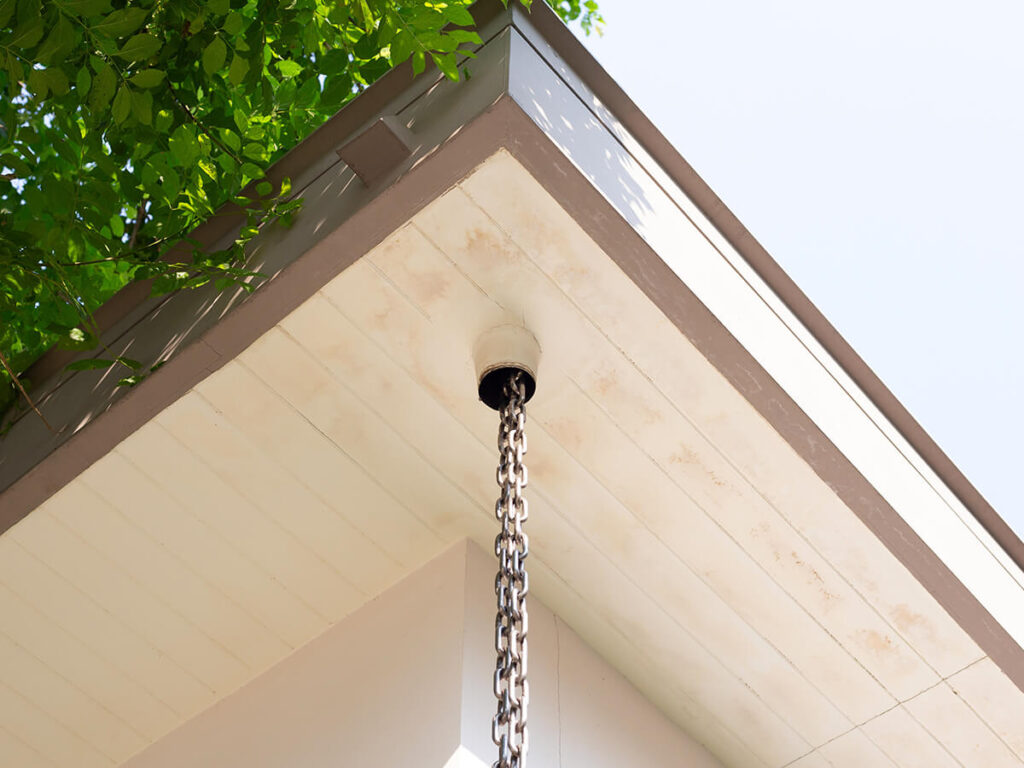
Rain chains, whether they are cup-style or link-style, are inherently “open.” They have no capacity to manage the sheer volume of water that a downspout can. During a heavy downpour, the water gushing from the eavestrough outlet will overwhelm the chain entirely. Instead of politely following the links, the torrent will simply shoot past it, cascading off the roof as if no downspout were present at all. This “overflow” dumps hundreds of gallons of water directly at the base of your home.
Failure Point 2: The Wind and Splash-Back Nightmare
Even if the water flow is more moderate, the open design of a rain chain introduces another catastrophic flaw: wind.
A downspout shields the water. A rain chain leaves it completely exposed. Any significant wind—a common feature in Calgary—will catch the falling water and atomize it, flinging it in a wide arc. This uncontrolled spray is blasted directly onto your home’s siding, windows, and doors.
This constant wetting leads to a cascade of problems. It can stain siding with dirt and debris washed from the roof. More dangerously, it drives moisture behind vinyl, wood, or stucco, leading to mold, mildew, and the slow, insidious rot of your home’s underlying sheathing. It saturates window and door frames, causing wood to swell and rot, breaking seals, and leading to leaks inside your home.
Failure Point 3: A Direct Attack on Your Foundation
The most significant and costly risk is to your foundation. A rain chain, by its very design, deposits all the water it catches in one concentrated spot, directly at the base of your house. Even if it drains into a decorative basin or a gravel pit, this feature will be overwhelmed in the first few minutes of a real storm.
You are, in effect, systematically watering your foundation. This creates a “saturation zone” in the soil immediately surrounding your basement. This leads to two critical dangers:
- Hydrostatic Pressure: The saturated soil becomes heavy and exerts immense pressure against the foundation walls. This pressure forces water through any microscopic crack or joint, leading to basement dampness, leaks, and destructive flooding.
- Erosion: The force of the water can gradually erode the soil supporting your foundation, leading to settling and structural cracks.
- Frost Heave: In our cold climate, this is the endgame. When the saturated soil freezes in winter, the water within it expands by about 9%. This expansion exerts thousands of pounds of pressure on your foundation, causing it to heave, shift, and crack. This is not a simple patch job; it is a structural failure that can cost tens of thousands of dollars to repair.
Failure Point 4: The Winter Ice Hazard
Calgary winters add another dimension of failure. Rain chains are not designed for snowmelt and ice. During freeze-thaw cycles, they become spectacular—and spectacularly heavy—columns of solid ice. This immense weight puts a severe strain on your eavestroughs, pulling them from the fascia board and potentially causing them to bend or collapse entirely, requiring a full system replacement. Furthermore, this creates a massive, hazardous ice patch on any walkway or driveway below.
Protecting Your Home: Choose Engineering Over Aesthetics
 Protecting Your Home: Choose Engineering Over Aesthetics
Your home is your most significant investment. Protecting its structural integrity is a primary responsibility, and this begins with robust, professional-grade water management. Compromising your entire drainage system for a simple aesthetic is a gamble that is just not worth the stakes.
This is why investing in high-quality, seamless gutters and fully enclosed downspouts is a foundational part of all serious exterior renovations. It’s not the most glamorous upgrade, but it is one of the most critical for safeguarding your property’s value.
You could, of course, install an artificial rain chain as a purely decorative garden feature, with water circulating down it from a small, self-contained pump. But as for using one in place of a downspout, we at Valiant Exteriors would never take that risk. It will just be our luck that a major storm breaks while we are out of town, and we return to a flooded basement and a catastrophic repair bill.
In the end, the choice is clear. Don’t let a picturesque fad compromise the very foundation of your home. Stick with the proven, engineered system that is designed to protect it.
For quality exterior renovations, gutters, eavestroughing, or sidings in Calgary, call Valiant Exteriors at (403) 829-1661.